
Share this 
February 23, 2026
More Risk Without the Reward
Would you buy a house without knowing what your monthly payments would be—or if you could even afford it? Would you purchase a house without knowing the financing options? Probably not. These unknowns are examples of what some groups encounter when they secure construction-only financing for their real estate projects.
While construction-only financing might initially seem like a flexible way to fund your building project, it comes with risk that can jeopardize your investment.
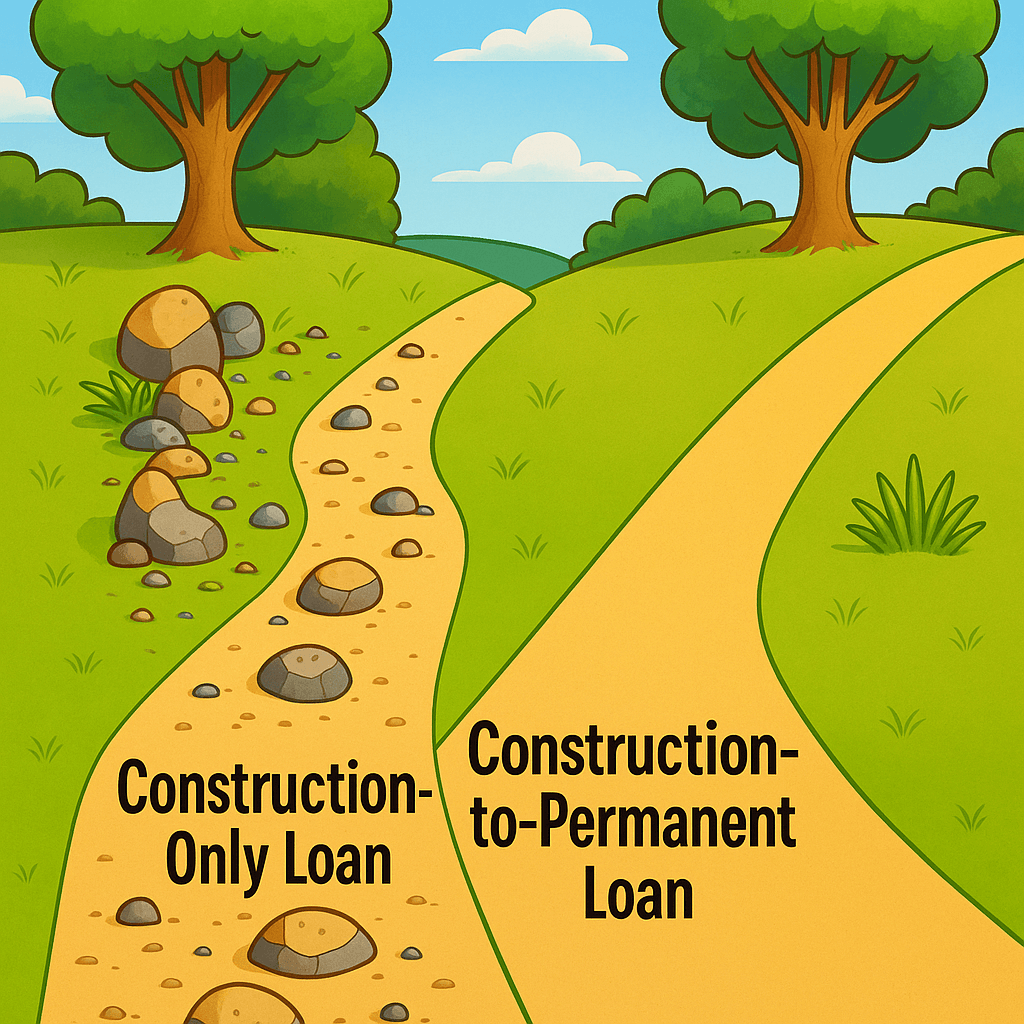
Here are just three primary risks you could be facing with construction-only financing:
1. Changes in the Economic Landscape
Unlike construction-to-permanent loans, construction-only financing covers only the build phase—leaving you to secure permanent financing once construction is complete. By that time, you may be facing a completely different economic landscape. If interest rates have risen or lending standards have tightened, you could find yourself unable to secure favorable (or even sufficient) terms. This uncertainty adds unnecessary stress and financial strain just when you expect to be settling into your newly completed property.
To put this into perspective, imagine securing construction-only financing that matured in mid-2008, or during the height of COVID, and consider how hard it would have been to secure permanent financing during this period of uncertainty.
2. Appraisal Conundrums
Construction-only financing requires a second appraisal at the end of the project to qualify for permanent financing. If the second appraisal comes in lower than expected—whether due to market shifts, valuation discrepancies, or simply a change in one appraiser’s opinion of the value— you may be forced to come up with a larger down payment or adjust your financing strategy entirely.
For example, suppose you secured an 85% LTV construction-only loan for a $20MM project. The initial “as-complete” appraisal matched the project cost, allowing you to borrow $17MM. However, upon completion of the property, the new “as-is” appraisal comes in at just $18MM. If lenders were unable to offer a higher LTV option, this caps the maximum loan amount to $15.3MM—leaving a $1.7MM shortfall that would need to be funded by the practice partners.
3. Weaker Negotiating Position
Another major concern is the shift in negotiating power during construction. With construction-only loans, the lender controls the draw schedules and disburses funds incrementally. This puts you in a vulnerable position: if the lender disputes or delays a draw request, it can stall your project and cause expensive delays. Do you really want to be negotiating with your lender on a permanent loan while they have this level of control over your project?
You might be thinking, "What if I believe long-term rates will decrease during construction and want to take advantage of that?" If that’s the case, the good news is—you can have your cake and eat it too:
- Wait to lock your interest rate
Assuming your loan proposal doesn’t include a hedging requirement, you have the option to float your interest rate during the construction phase and lock it in after the project is complete—or even later. The key advantage is that you still have a permanent loan in place from the onset, which specifies the loan spread you’ll pay. This means there’s no need to renegotiate with lenders or obtain another appraisal.
- Limit your prepayment penalty
If you’re able to negotiate a reduced prepayment penalty, you’ll have greater flexibility to refinance at a more favorable time with minimal costs—but keep in mind, you may be giving up a better rate to receive this benefit.
- Lock your rate for a shorter term
If you anticipate rates will decline, you might structure a long-term loan with a shorter fixed-rate period -for example, fixing the rate for just 3 years on a 10-year loan. After that period, the remaining 7 years would either float or give you the option to re-lock the rate at that time, hopefully in a more favorable interest rate environment.
The obvious drawback with these strategies is the unpredictability of interest rates. While rates could decline, there's also a very real possibility they’ll rise by the time construction is complete or when you’re ready to adjust your rate. If you have a higher risk tolerance, these options may offer potential upside without taking on the aforementioned risks. That said, in our experience, many clients prefer the certainty of a “bird in the hand” rather than gambling on “two in the bush.”
Groups that lock in their interest rate at the start of construction have the advantage of knowing exactly what their monthly payments will be for the 7 to 10 years following project completion. This certainty allows them to accurately forecast cash flow and project returns—providing peace of mind. Just as importantly, it eliminates ambiguity around investor expectations.
In short, construction-only financing leaves too many critical variables out of your control. Opting for a construction-to-permanent loan instead provides greater predictability, simplifies the process, and shields your project from financial turbulence at a critical time.
by - CMAC
Share this